The Quiet Boom: How Overlooked Heartland Cities Are Rewriting the Tech Map
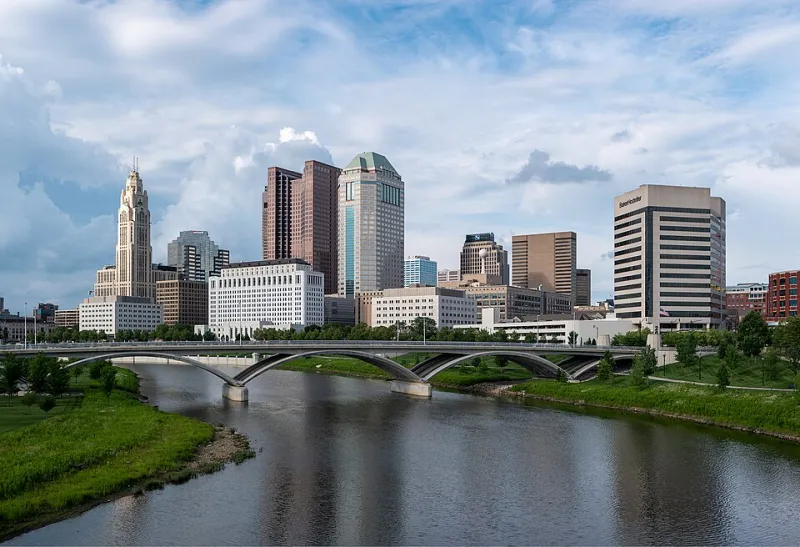
Photo: Paul Wasneski, Public domain, via Wikimedia Commons
On a Tuesday afternoon in late 2023, a software engineer named Priya Mehta closed her laptop in a two-bedroom apartment in San Francisco's Mission District, booked a one-way flight to Columbus, Ohio, and did not look back. Her salary from a cloud infrastructure company remained unchanged. Her rent dropped by more than $2,000 per month. Within eight months, she had co-founded a small fintech startup with two former colleagues who had made similar moves—one to Madison, Wisconsin, one to Des Moines, Iowa.
"I kept waiting for the catch," Mehta said in a recent interview. "There wasn't one."
Mehta's trajectory is increasingly common, and the cities she and her peers are choosing are increasingly prepared to receive them. Across a band of Midwestern metros that were, for most of the past two decades, afterthoughts in conversations about American innovation, a quiet but measurable transformation is underway. Remote work has decoupled talent from geography in ways that are still rippling through local economies, real estate markets, and civic planning offices from the Ohio River to the upper plains.
The question animating policymakers, investors, and economists alike is whether this represents a genuine and lasting rebalancing of American economic geography—or a temporary anomaly that will fade as remote work norms continue to evolve.
The Numbers Behind the Narrative
The data, while not yet conclusive, is suggestive. The U.S. Census Bureau's American Community Survey has recorded net positive domestic migration into Columbus, Madison, and Des Moines for three consecutive years, a reversal of longer-term trends that had seen those cities lose educated young adults to coastal markets.
Venture capital flows tell a similar story, albeit with more modest figures. According to PitchBook data, the combined metro areas of Columbus, Indianapolis, Kansas City, and Minneapolis attracted approximately $4.2 billion in venture investment in 2023—a figure that remains dwarfed by the Bay Area's totals but represents a compound annual growth rate of roughly 18 percent over the preceding five years. Early-stage deal activity has been particularly pronounced, suggesting that founders are choosing these markets at the inception of their companies rather than simply relocating after initial funding.
State and local governments have accelerated the trend through targeted incentive programs. Ohio's TechCred initiative has reimbursed employers for thousands of technology-focused credentials, building a workforce pipeline that startups can tap without the recruitment costs associated with coastal labor markets. Iowa's Economic Development Authority has offered a suite of tax credits specifically designed to attract remote workers who establish legal residency and, eventually, local businesses.
The Quality-of-Life Calculus
Beneath the policy architecture lies a simpler arithmetic that workers are performing on their own. The cost differential between major coastal metros and their Midwestern counterparts remains striking. Median home prices in Columbus run roughly one-third of comparable properties in Seattle. Madison's cost of living index sits approximately 40 percent below San Francisco's. For workers whose compensation is benchmarked to coastal markets—a group that expanded dramatically as technology companies adopted location-agnostic pay scales during the pandemic—the purchasing power advantage is immediate and substantial.
But analysts caution against reducing the trend to housing costs alone. Interviews with recent migrants to these cities consistently surface a broader set of considerations: commute times measured in minutes rather than hours, proximity to outdoor recreation, the social legibility of mid-sized urban environments, and, for those with families, school quality and neighborhood stability.
"There's a cohort of workers in their early thirties who made a very rational decision," said Dr. Alicia Forsythe, an urban economist at the University of Michigan. "They looked at what coastal cities were actually delivering relative to what they cost, and they found the value proposition wanting. The Midwest offered a credible alternative in a way it simply hadn't for the previous generation."
Infrastructure: The Persistent Gap
The optimistic narrative, however, carries significant caveats. The same cities attracting remote workers and venture capital continue to face infrastructure limitations that could constrain their growth trajectories.
Broadband access remains uneven across the broader metro regions surrounding these cities. While urban cores have generally adequate connectivity, the exurban and rural counties that represent potential overflow zones for housing-cost-driven migration lag considerably. Federal investment through the Infrastructure Investment and Jobs Act has allocated substantial funds for broadband expansion, but deployment timelines stretch years into the future.
Public transit presents a more immediate challenge. Columbus, despite its growth, lacks a rail network and relies almost entirely on automobile infrastructure. Des Moines' bus system serves a fraction of its metro area. For workers accustomed to car-free urban living in cities like New York or Chicago, the adjustment is real. Several founders and executives interviewed for this article cited transportation as the factor most likely to limit the long-term appeal of Midwest tech hubs for talent drawn from the densest coastal markets.
Flight connectivity adds another layer of complexity. While major Midwest airports provide adequate access to domestic business travel, the frequency and directness of international routes trails that of coastal gateway cities—a material consideration for companies with global operations or investor relationships.
The Anchor Institution Advantage
What distinguishes the cities making the most progress from those that have talked about tech hub ambitions without realizing them is often the presence of strong anchor institutions: major research universities, established healthcare systems, and legacy industrial firms with the resources to invest in adjacent innovation ecosystems.
Columbus benefits from Ohio State University's research output and its growing commercialization infrastructure. Madison is, in many respects, an extension of the University of Wisconsin's intellectual community. Des Moines has leveraged its position as an insurance industry capital to build a credible insurtech cluster, drawing on decades of accumulated actuarial and financial services talent.
"These cities aren't starting from scratch," noted James Okafor, a partner at a Chicago-based venture fund with significant Midwest portfolio exposure. "They have knowledge bases, they have institutional relationships, they have a professional services infrastructure. What they lacked was density of early-stage capital and a critical mass of founders. That's changing."
Durable Shift or Cyclical Blip?
The honest answer is that it is too early to know with certainty. The forces driving Midwestern tech growth—remote work norms, coastal affordability crises, targeted public investment—are real but not guaranteed to persist at current intensity. If large technology employers continue to tighten return-to-office requirements, the pool of location-flexible workers will shrink, and the arbitrage opportunity that has powered Midwest migration may narrow.
What seems increasingly clear, however, is that the prior assumption—that meaningful technology ecosystems could only exist in San Francisco, Seattle, New York, and Boston—has been empirically challenged. The cities of the American interior are not simply beneficiaries of a temporary disruption. They are building the institutional and human capital foundations for something that may prove considerably more durable than a trend.
For the workers, founders, and investors who have already made their bets, that distinction matters less than the daily reality of a professional life that costs less, moves more easily, and feels, for the first time in a long time, genuinely sustainable.