Beyond the Checkbox: What Disability Accommodation Practices Reveal About Corporate America's Real Values

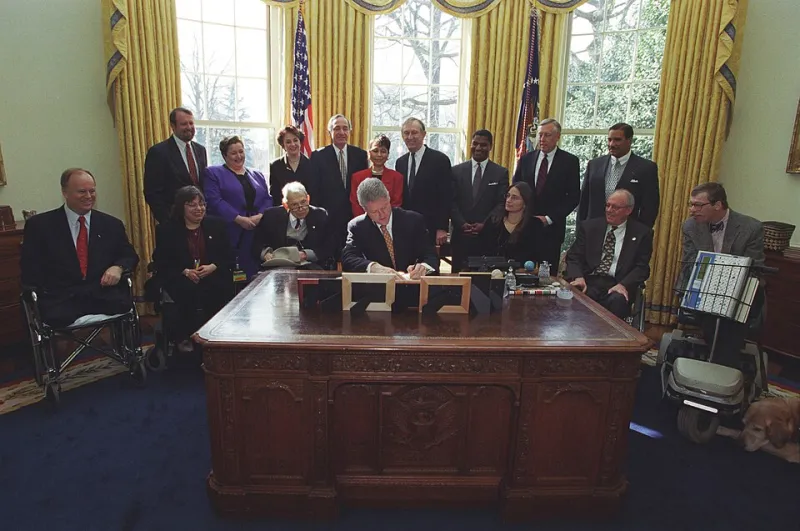
Photo: Shixart1985, CC BY 2.0, via Wikimedia Commons
When a financial analyst at a mid-sized investment firm in Chicago requested a screen-magnification tool and adjusted lighting following a diagnosis of macular degeneration, she expected a straightforward administrative process. What followed instead was a months-long exchange involving HR, her direct supervisor, and the company's legal department. By the time the accommodation was approved, she had been passed over for a team leadership role. The official reason cited was "timing."
Her experience is not an outlier.
Across American industries, the gap between what the law requires and what employees actually encounter when they request disability accommodations remains wide and, in many cases, widening. The Americans with Disabilities Act, enacted in 1990 and significantly strengthened by the ADA Amendments Act of 2008, obligates employers with fifteen or more workers to provide reasonable accommodations unless doing so creates an undue hardship. On paper, the framework is robust. In practice, its application is deeply uneven.
A Legal Floor, Not a Cultural Ceiling
Data from the Equal Employment Opportunity Commission illustrates the scale of the problem. Disability discrimination charges have consistently ranked among the most frequently filed complaints with the agency, accounting for more than 36 percent of all charges in the most recently reported fiscal year. A substantial portion of those cases involve the accommodation process specifically—either outright denials or what employment attorneys describe as "constructive denial," in which requests are delayed, questioned repeatedly, or subjected to burdensome documentation requirements until workers abandon them.
Researchers at Cornell University's Yang-Tan Institute on Employment and Disability have found that many employers conflate compliance with inclusion. A company may technically fulfill its legal obligations—approving a standing desk or permitting a modified schedule—while simultaneously communicating through tone, process, and managerial behavior that the request was unwelcome. That distinction, subtle on its surface, carries measurable professional consequences.
"The law tells you what you cannot do," said one employment attorney based in Washington, D.C., who has represented disabled workers in accommodation disputes. "It says very little about how you treat someone during the process, or what happens to their career afterward."
When Accommodation Becomes a Career Liability
Among the least-discussed dimensions of workplace disability policy is what researchers call the "accommodation penalty"—the documented tendency for employees who formally request accommodations to experience slower promotion timelines, reduced visibility on high-profile projects, and subtler forms of professional marginalization.
A 2022 study published in the Journal of Applied Psychology found that managers, even those with no conscious bias against disabled employees, rated accommodation-requesting workers as less "committed" and less "promotable" than peers with equivalent performance records. The researchers characterized the effect as rooted in implicit assumptions about reliability and long-term organizational investment.
For workers, this creates a calculated dilemma: pursue the accommodation they need to perform effectively, or protect their career trajectory by managing the disability without institutional support. Many choose the latter, often at significant personal cost.
Data from the Job Accommodation Network, a federally funded technical assistance center, suggests that the vast majority of accommodations cost employers nothing at all, or less than five hundred dollars to implement. Yet the perception of accommodation as burdensome persists across management levels, particularly in industries defined by high performance pressure and competitive cultures, such as finance, technology, and professional services.
Organizations That Get It Right—and Why
Not all employers replicate this pattern. A growing number of organizations have restructured their accommodation processes in ways that measurably reduce both delays and cultural stigma, and the results carry implications beyond compliance metrics.
Microsoft has been widely cited for its inclusive design initiatives, which extend into HR practice through a process designed to treat accommodation requests as a standard operational matter rather than an exception requiring special justification. Internal benchmarking at several large employers has shown that streamlining the accommodation workflow—reducing approval layers, training frontline managers on process norms, and eliminating redundant medical documentation requirements—correlates with higher retention rates among disabled employees and, notably, broader workforce satisfaction scores.
The federal government itself, one of the largest employers in the country, has made measurable strides through its Workforce Recruitment Program and centralized accommodation fund model, in which accommodation costs are absorbed at the agency level rather than charged to individual department budgets. That structural shift removes a key source of managerial resistance, since supervisors no longer face a financial disincentive when approving requests.
Some private-sector firms have adopted similar approaches. A handful of Fortune 500 companies have moved toward what disability inclusion advocates describe as a "universal design" philosophy—proactively building flexibility into job structures rather than treating accommodation as a reactive, individualized exception. The logic is straightforward: a workplace designed with flexibility at its core requires fewer formal accommodations because the environment is already adaptable.
The Disclosure Dilemma
Underpinning all of this is the question of disclosure. Employees are not legally required to reveal a disability unless they are requesting an accommodation, and many choose not to. The reasoning is rational: in cultures where accommodation requests are treated as professional liabilities, non-disclosure becomes a survival strategy.
The Disability Statistics Compendium, maintained by the University of New Hampshire, estimates that roughly one in four American adults lives with some form of disability. Yet workplace surveys consistently show that only a fraction of that population discloses to their employer. The divergence between prevalence and disclosure rates is itself a diagnostic tool—it suggests that many workers do not trust the system designed to support them.
HR professionals who specialize in disability inclusion point to this trust deficit as the central challenge. Legal compliance, they argue, is the beginning of the conversation, not its conclusion. The harder work involves building a managerial culture in which requesting support is treated as a sign of self-awareness and professional engagement rather than as evidence of diminished capacity.
Measuring What Matters
Corporate diversity, equity, and inclusion reporting has expanded significantly over the past decade, but disability representation remains among the least rigorously tracked dimensions of workforce composition. Many companies that publish detailed breakdowns of gender and racial demographics offer only vague or absent data on disability.
Advocacy organizations including the American Association of People with Disabilities have called for standardized voluntary self-identification practices and more transparent reporting on accommodation outcomes, including approval timelines and post-request career trajectory data. Without that information, they argue, it is nearly impossible for workers, investors, or policymakers to assess whether corporate commitments to disability inclusion reflect operational reality.
For the analyst in Chicago, the question is less abstract. After nearly two years with her employer, she left for a smaller firm that had, in her words, "handled the whole thing in an afternoon." She received her accommodation, was promoted within eighteen months, and has since become an informal mentor to colleagues navigating similar processes.
The cost of her former employer's approach—losing an experienced, high-performing employee—was entirely avoidable. Whether that lesson registers across corporate America may depend less on the law than on whether organizations choose to treat inclusion as a genuine operating value rather than a liability to be managed.